By the SAAFO Safaris team | Last updated: October 2026
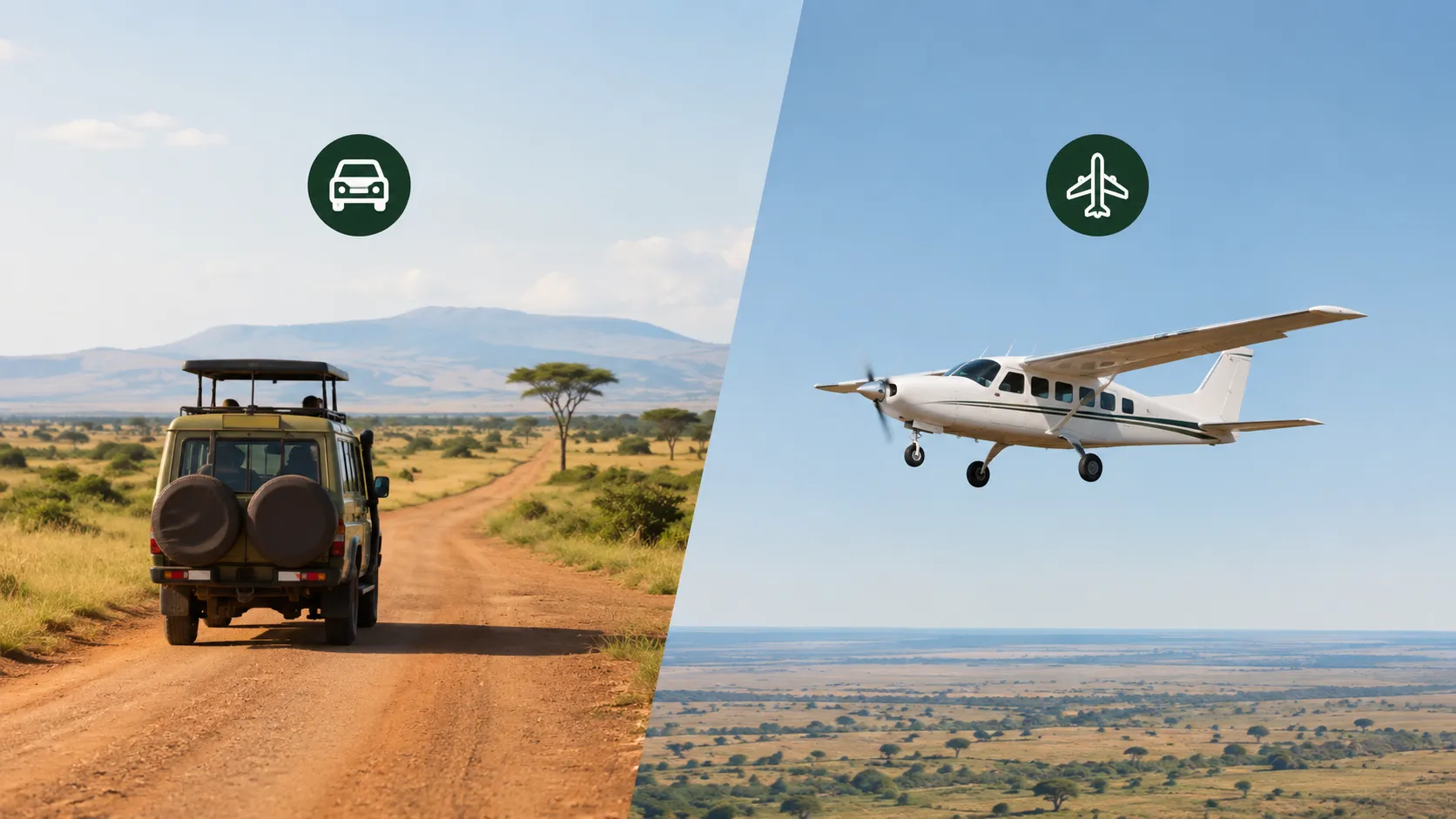
Planning how to get from Nairobi to Masai Mara is the first real decision of any Mara trip, and it shapes your budget, your energy, and how many hours you actually spend watching wildlife. You can drive in about five to six hours or fly in under an hour, and each option suits a different kind of traveler. This guide compares both routes with real distances, drive times, flight costs, and 2026 park fees, so you can choose before you book your Masai Mara safari.
If you are still deciding when to go, read our guide to the best time to visit Kenya for a safari first, since July to October traffic and flight availability differ a lot from the green season. Our Kenya safari costs guide covers the budget side in more depth, and you can also browse our safari tour packages to see itineraries where transport is already arranged, such as our 3-day Masai Mara and Lake Naivasha safari.
Factor | By Road | By Air |
|---|---|---|
Distance | About 225 to 270 km, depending on gate | Same route, flown directly |
Travel time | 5 to 6.5 hours | 45 to 60 minutes in the air |
Door to door | 5 to 7 hours | About 2 to 3 hours including Wilson Airport check-in |
Typical cost | Included in most group and private safari packages | Roughly $150 to $350 one-way per person |
Best for | Budget travelers, scenery lovers, Kenyan residents | Short trips, families, honeymooners, luxury travelers |
The standard route leaves Nairobi on the A104, drops down the Mai Mahiu escarpment into the Great Rift Valley, and continues through Suswa to Narok town. From Narok, the road runs to the reserve gates, and the last stretch to Sekenani Gate is now tarmac for most of the way. Allow roughly five to six hours for the eastern gates, with one stop in Narok.
Leg | Approx. Distance | Typical Time |
|---|---|---|
Nairobi to Narok | 140 to 145 km | 2.5 to 3 hours |
Narok to Sekenani Gate | 85 to 90 km | 1.5 to 2 hours |
Gate to your camp | Varies | Up to 1 hour of park tracks |
The Nairobi to Masai Mara drive is scenic, especially the viewpoint over the Rift Valley, but it is long. If you would rather break it up, many travelers spend a night at Lake Naivasha first, which is exactly how our Kenya safari packages often structure the first day. A single stalled truck on the escarpment can add hours, which is why departure time matters more than distance. Leave by 6am or 7am if you want to reach camp for a late-morning or early-afternoon game drive, and avoid driving after dark.
There are three common ways to cover the road. A group safari vehicle is the cheapest per person because the cost is shared, and it removes all the navigation stress. A private vehicle with a driver-guide costs more but lets you set your own pace and stops, which suits families and small groups. Self-drive is possible and popular with residents, but you need a high-clearance vehicle for park tracks, offline maps, and plenty of fuel and cash before leaving Narok. If you rely on a phone map, double-check the route to your specific gate, because some navigation apps suggest rougher shortcuts that add hours.
The gate you enter through changes your drive time, so confirm it with your camp before you set off.
Gate | Side of Reserve | Approx. Drive from Nairobi |
|---|---|---|
Sekenani | East | 5 to 6 hours |
Talek | Central | 5.5 to 6.5 hours |
Oloolaimutia | South-east | About 6 hours |
Musiara and Oloololo (Mara Triangle) | West and north-west | 6 to 7.5 hours |
All scheduled flights to the Mara leave from Wilson Airport in Nairobi, not Jomo Kenyatta International Airport. Wilson is roughly 17 km from JKIA, so allow 25 to 90 minutes to transfer between the two depending on traffic. Flights are operated by carriers such as Safarilink and AirKenya, with several other bush operators also serving Mara airstrips.
The flight itself takes about 45 to 60 minutes, landing on a grass airstrip close to your camp. Many travelers save time by flying one way, which brings us to the next section. Because bush planes are small, luggage is usually limited to soft-sided bags of around 15 kg, so check your allowance with the airline and use our East Africa safari packing checklist to pack light.
Question | Road | Flight |
|---|---|---|
Is it cheaper? | Yes, especially in a shared or group package | No, adds roughly $300 to $700 per person return |
Which saves time? | No | Yes, saves around three hours each way |
Do you see scenery on the way? | Yes, Rift Valley and Maasai farmland | Aerial views, but less of the countryside |
Which is easier with children? | Long for young kids | Usually easier, see our family safari in Kenya guide |
Which suits a short trip? | Works for 3 days or more | Best for 2 to 3 nights |
Choose the road if you are on a budget, traveling as a group, or want a drive-in experience. Choose the flight if time is tight, you have young children, or you are planning a romantic trip and want to arrive fresh, as in our honeymoon safari ideas in Kenya. A popular compromise is to drive in and fly out, or the reverse, which saves half the travel time while keeping the cost lower than a full return flight.
Transport is only part of the bill, so here is how the main costs line up in 2026.
Cost Item | Indicative 2026 Figure |
|---|---|
Return road transfer | Usually bundled into your safari package price |
One-way bush flight | Roughly $150 to $350 per person |
Reserve entry, non-resident adult | $100 per day (Jan to Jun), $200 per day (Jul to Dec) |
Reserve entry, non-resident child (9 to 17) | $50 per day |
Reserve entry, Kenyan citizen | KES 1,500 per day (Jan to Jun), KES 3,000 per day (Jul to Dec) |
Park fees apply per person, per day, and they roughly double from 1 July, so travel dates affect your total more than the choice between road and air. Our Kenya safari costs guide breaks down accommodation, tips, and add-ons for budget, mid-range, and luxury trips. Fees and fares change, so always confirm current figures when you book.
Roads and flights both fill up between July and October, when the Great Migration arrives. If you are traveling for the crossings, book flights and camps early and read our guide to the Masai Mara Great Migration river crossings. In the green season from March to May, roads can be slower after rain, so allow extra time or consider flying.
How far is the Mara from Nairobi? By road it is roughly 225 to 270 km depending on the gate, which takes about five to six hours. By air the same trip takes 45 to 60 minutes.
How long is the flight to the Mara from Nairobi? Scheduled flights from Wilson Airport take about 45 to 60 minutes, though total journey time including check-in is usually two to three hours.
Is the road to the Mara tarmac? Most of it is. The route to Narok is tarmac and the road from Narok to Sekenani Gate is now largely paved, though some western routes still include unpaved sections.
Should I drive or fly to the Mara? Drive if you are on a budget or want the scenery. Fly if you have limited time, young children, or want to arrive rested. Many travelers do one of each.
How much are the Masai Mara entry fees in 2026? Non-resident adults pay $100 per day from January to June and $200 per day from July to December. Kenyan citizens pay KES 1,500 and KES 3,000 per day over the same periods.
Whether you drive or fly, we arrange the transfers, camps, and guides so the journey from Nairobi to Masai Mara is the easy part. Explore our safari tour packages or safari destinations in East Africa, or contact our team for a custom itinerary.