Watching the Masai Mara Great Migration river crossings is the single most dramatic wildlife spectacle in Africa, and arguably on earth. Over 1.5 million wildebeest, alongside hundreds of thousands of zebra and gazelle, funnel toward the Mara River and hurl themselves across it in chaotic, adrenaline-charged surges, often with crocodiles waiting below. Timing and location both matter enormously here, since being in the wrong spot on the wrong week can mean missing it entirely. Here’s exactly when and where to position yourself.
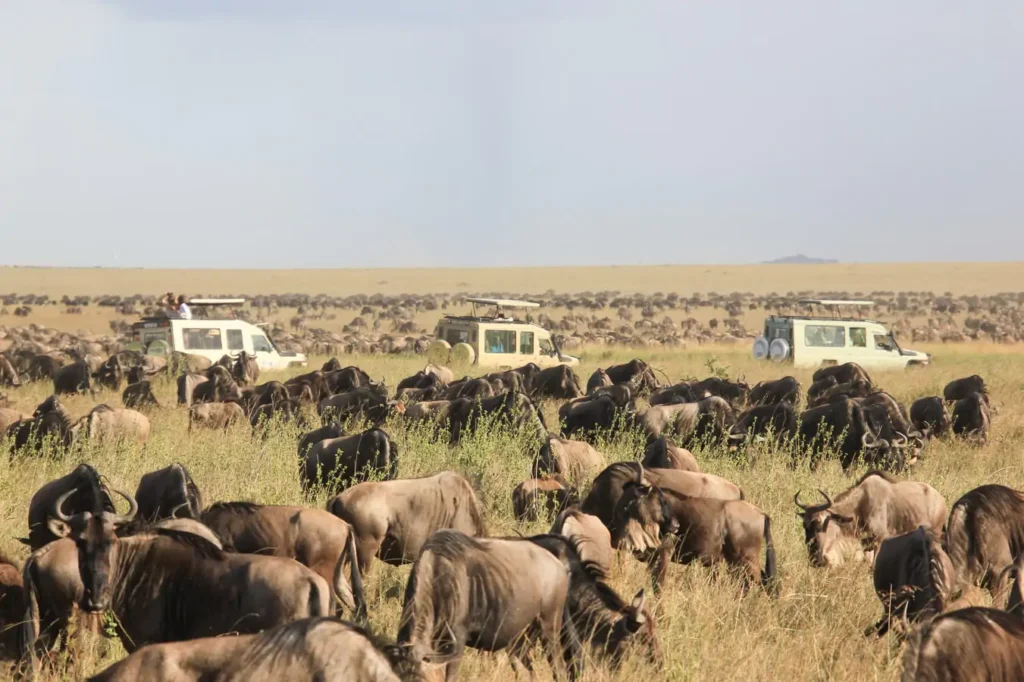
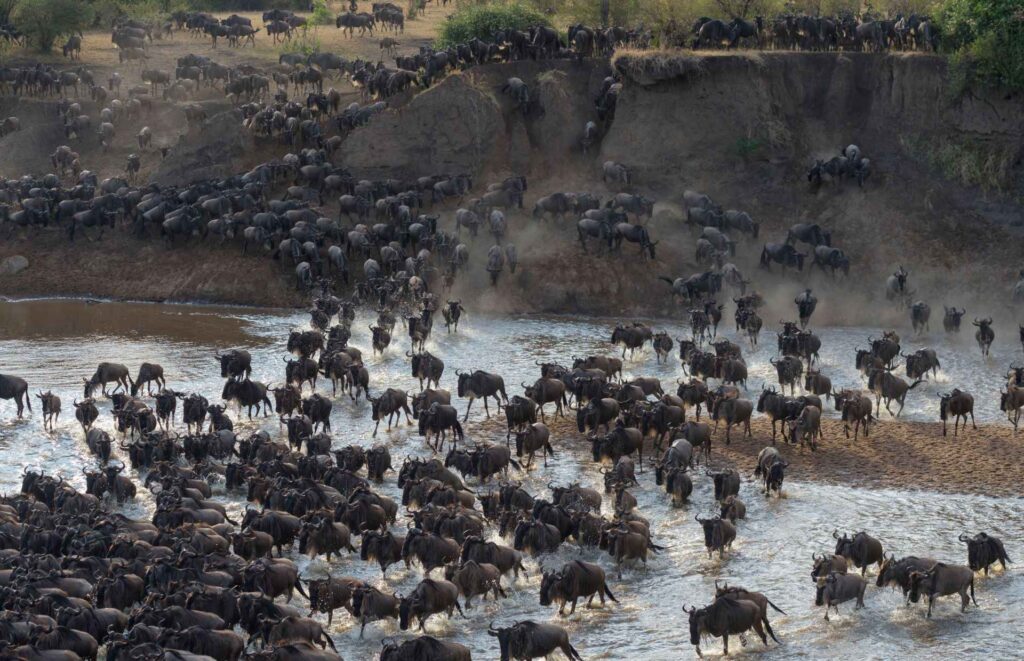
As the migration moves from Tanzania’s Serengeti into Kenya’s Masai Mara in search of fresh grazing, the herds must cross two rivers, the Mara River and the smaller Talek River. These crossings aren’t scheduled or predictable to the day. Herds gather at the riverbank, sometimes for hours, building up numbers, pacing, bellowing, and testing the water’s edge before a single animal takes the plunge and triggers a chain reaction of thousands following behind it. Dust rises off the herd, hooves pound the earth, and the noise alone, thousands of wildebeest grunting at once, is something photographs never quite capture. It’s tense, unpredictable, and part of what makes it so compelling to witness in person rather than just watch in a documentary.
It’s worth understanding why this happens, since it makes the spectacle far more meaningful to watch. The migration isn’t a single event but a continuous, circular movement driven by rainfall and grazing. As the Serengeti’s southern plains dry out after the short rains, the herds instinctively push north toward the Mara, where the seasonal pattern keeps grass greener for longer, and the river simply sits in that path. Crossing it isn’t a choice the animals make lightly, since drowning, exhaustion, and predation are all real risks, but the pull toward fresh grazing overrides that caution. It’s this tension between survival and risk that makes a crossing feel less like a sighting and more like watching an ancient migration play out in real time.
The Great Migration follows a broadly predictable annual pattern, but exact dates shift year to year depending on rainfall:
If a single river crossing is the main reason for your trip, August and September give you the highest odds, though nothing in nature is ever guaranteed. For the fuller picture of Kenya’s safari calendar beyond just the migration, see our guide on the best time to visit Kenya for a safari.
Location matters as much as timing. The Mara River winds through both the reserve and the surrounding private conservancies, and a handful of points along it consistently attract the biggest crossings:
No single point guarantees a crossing on any given day. Herds gather, hesitate, and sometimes disperse without crossing at all, which is why guides who track herd movement daily make such a difference to your chances.
A river crossing is rarely just about the wildebeest. The Mara River is home to some of Kenya’s largest Nile crocodiles, many of which have grown enormous by timing their year around the migration. As herds enter the water, crocodiles position themselves in the deeper channels, and witnessing an actual kill mid-crossing isn’t unusual. Lions and leopards also learn to patrol known crossing points, often waiting on the exit bank where exhausted, disoriented animals are easiest to target, and vultures typically follow soon after to clean up what’s left. None of this is staged, it’s simply a predator-prey ecosystem working at full scale, and it’s part of what makes a crossing so different from a standard game drive.
Experienced guides rarely stumble onto a crossing by luck, they read the herd’s behavior. A large gathering of wildebeest bunching tightly along the riverbank, kicking up dust, and pacing back and forth without settling is usually the first clue. Listen for the pitch of the grunting to rise as animals grow more agitated, and watch for a lone, braver individual, often called a “leader,” stepping toward the water’s edge and testing the current before retreating. That hesitation can repeat for minutes or hours before something finally tips the herd into committing. If a predator is spotted nearby, on either bank, herds will often delay a crossing entirely or abandon the attempt and move further along the river to try a different point. Recognizing these cues is exactly why watching a Masai Mara Great Migration river crossing with an experienced guide, rather than self-driving, makes such a difference to your chances of actually seeing one unfold.
Where you base yourself affects both your access to crossing points and your overall experience:
Many travelers split their stay between a conservancy for exclusivity and the reserve for closer access during peak weeks. Our Masai Mara destination page has more on the reserve’s sectors if you’re deciding where to base your trip.
A zoom lens in the 100 to 400mm range covers both wide herd shots and tighter action. Shoot from the exit bank where possible, since that’s usually where the most dramatic moments, panic, predators, and scrambling up muddy banks, actually happen. Use a fast shutter speed, at least 1/1000s, and burst mode, since the best moment of a crossing often lasts only a second or two. And put the camera down for at least part of it. This is one of the few wildlife moments genuinely worth experiencing directly rather than only through a screen.
Even well-planned trips can miss the spectacle if a few common mistakes creep in. The biggest one is booking a single-night stopover expecting to catch a crossing on cue, when in reality herds can gather at a riverbank for hours and then simply walk away without crossing at all, only to try again the next day. Another frequent mistake is chasing every rumor of a crossing from other vehicles over the radio, which often means arriving after the action has already happened rather than positioning early and waiting. Some travelers also focus so heavily on the exact peak months that they overlook July and early October, both of which can deliver excellent Masai Mara Great Migration river crossings with noticeably fewer vehicles crowding the bank. Finally, don’t underestimate the value of a knowledgeable guide over a slightly cheaper self-drive option, since guide expertise is often the deciding factor between watching a crossing unfold and driving past an empty riverbank.
Since the same migration moves between both countries, this is a common point of confusion for first-time travelers. Broadly, the Mara River crossings in Kenya are most active from July through October, while the Serengeti side in Tanzania tends to be better for calving season (January to March) and the southern plains migration. If you’re still deciding between the two, our detailed comparison on Kenya vs Tanzania Safari breaks down which country fits your travel dates and priorities.
How long does a Mara River crossing last?
A single crossing can be over in under a minute or stretch on for 20 to 30 minutes if the herd crosses in repeated waves, with gathering and hesitation beforehand often lasting far longer than the crossing itself.
Can you guarantee seeing a river crossing?
No safari operator can guarantee it, since crossings depend entirely on wild animal behavior and rainfall patterns. Staying multiple nights during peak months gives you the best realistic chance of witnessing the Masai Mara Great Migration river crossings in person.
Which month has the most river crossings?
August and September are generally considered the strongest months, though late July and early October can also produce strong crossings with smaller crowds along the riverbank.
Timing a trip around the Masai Mara Great Migration river crossings takes local knowledge and flexibility, and that’s exactly what we build into every migration season itinerary. Explore our 7-Day Kenya Expedition or the 8-Day Bespoke Big Five Safari, both of which can be timed around peak crossing months, or browse our full safari tour packages. For a tailor-made migration itinerary, get in touch with our team.